
Hurricanes Don't Wait.
Talk to our emergency logistics team before the next storm hits.
Get Help.


Protecting temperature-sensitive freight during extreme weather events requires careful planning. Heat waves, thunderstorms, hurricanes and snowstorms are all examples of weather that can spoil perishable goods. Implementing the right packaging, insulation and preconditioning practices can help ensure your temperature-sensitive goods arrive at the final destination without spoiling.
Shippers of temperature-sensitive freight should use an emergency logistics provider when extreme weather creates transportation or cold-chain problems their normal carrier network can’t reliably handle.
Here are some scenarios where using one can be helpful:
Using an emergency logistics provider doesn’t have to be your last resort. If you know a hurricane, snowstorm, or tropical storm is coming, it’s best to set up an arrangement with an emergency logistics provider.
While extreme weather can come in different forms, it can lead to many of the same problems for temperature-sensitive freight. These include temperature fluctuations, shipping delays, inventory management challenges, and power outages. Any of these issues can lead to perishable goods spoiling.
When shippers think of temperature fluctuations affecting their perishable goods, they often assume warm temperatures will spoil their goods. Weather events like heat waves or hurricanes can cause this problem.
However, perishable goods can be destroyed if they’re kept at a temperature that’s too cold. Essential medical goods like insulin, injectable biologics and antibiotics can lose their effectiveness if they’re exposed to freezing temperatures.
Temperature-sensitive products often have an expiration date, which makes delivering them to the final destination on time a must. However, certain extreme weather events can delay freight shipments until conditions are safe for travel. This can lead to temperature-sensitive freight being stuck inside a trailer or warehouse past its expiration date.
Here are some ways different weather events can delay your freight shipments:
Spoiled goods can lead to lost profits and unhappy customers and leave victims of natural disasters without the medical supplies they need.
Extreme weather events damage goods and cause spikes in demand, all of which make managing inventory more difficult.
Hurricanes, tropical storms and snowstorms can spoil or damage goods by exposing them to direct precipitation, flooding or melting snow, and condensation caused by temperature and humidity changes. This can cause perishable freight to spoil.
Hurricanes and tropical storms bring strong winds that can blow over reefer trailers and throw debris into refrigerated warehouses, resulting in damage to the goods inside.
Demand for certain perishable goods can increase during disaster recovery, such as:
Businesses that sell temperature-sensitive goods will have to replenish their inventory quickly to keep up with the increase in orders they receive following a natural disaster.
Temperature-sensitive goods require refrigeration to stay fresh while inside a warehouse. Extreme weather events from hurricanes to snowstorms can result in power outages. Without refrigeration units to keep perishable goods at the right temperature, they can begin to spoil.
To protect your temperature-sensitive freight during severe weather, you’ll need to know the temperature at which they should be kept during their journey through the supply chain. Above all else, you’ll want to ensure your goods are kept out of the “danger zone”. The danger zone is the temperature range that bacteria grows most rapidly in, which is between 40 ℉ and 140 ℉.
Fortunately, there are methods shippers can use to help maintain the temperature of their freight during extreme weather events.
These practices reduce the risk of your goods becoming spoiled or damaged due to extreme weather.
You can protect your temperature-sensitive freight from extreme weather events using insulation and phase change materials (PCM). There are numerous options for both that we’ll go over.
While refrigeration units play an important role in keeping perishable goods at the appropriate temperature, insulating your packages before they're palletized is another layer of protection you can use. Here are the different types of insulation you can use to protect your temperature-sensitive goods.
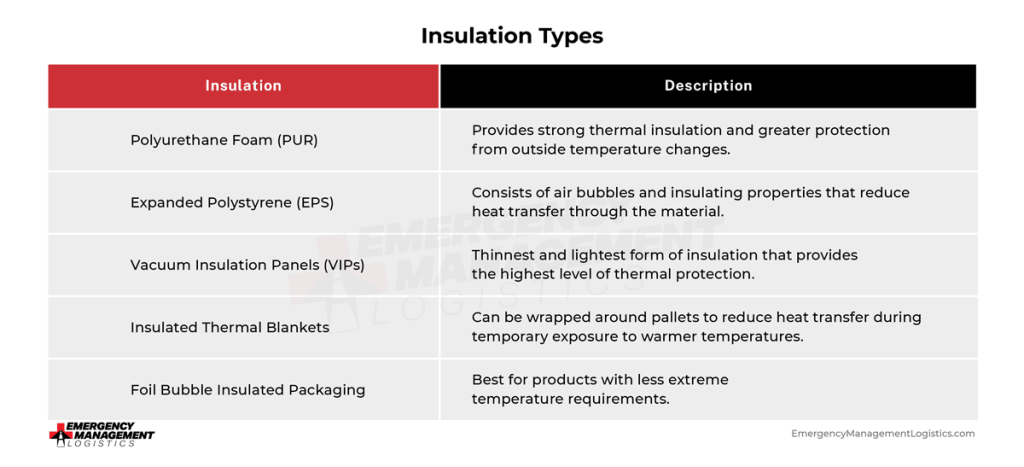
The type of insulation you need ultimately depends on the severity of the weather and the temperature requirements of your goods.
A PCM is a substance that absorbs or releases large amounts of thermal energy as it changes states between a liquid and a solid. It’s especially versatile because it can be used for both heating and cooling.
This means you can use it to protect your freight from weather events that result in extreme heat, like heat waves, or weather that results in extreme cold, such as snowstorms.
PCMs typically come in the form of small rectangular packs and are placed in packages prior to shipping. Here’s a graphic showing the different types of PCMs you can use.
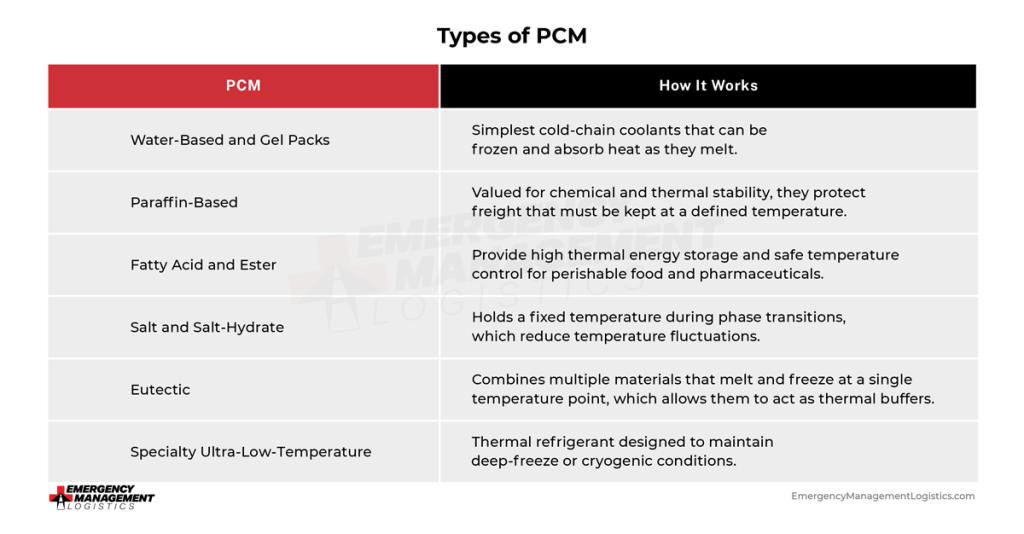
If extreme weather knocks out power to a warehouse or a reefer trailer malfunctions, PCM packs are your last line of defense.
Weather events can expose temperature-sensitive freight to warmer temperatures, which means preconditioning your goods before loading them in a trailer is important. You can do this by keeping products at the right temperature, preconditioning packaging and refrigerants and avoiding temperature excursions.
The first step is to keep your perishable goods at the right temperature. They should be stored at the correct temperature between 24 and 72 hours prior to shipping to ensure they maintain their freshness.
Preconditioned packaging and refrigerants ensure your temperature-sensitive freight stays cool during the loading and shipping process. Anything from dry ice, ice packs, gel packs and other varieties of PCMs should be preconditioned to the temperature at which your perishable goods should be kept.
Packaging and refrigerants that are preconditioned add an extra level of support in case extreme weather puts your goods in an environment outside their required temperature.
A temperature excursion is any event in which a temperature-sensitive product is outside its required safe storage or shipping range. During severe weather events, the risk to your temperature-sensitive freight will be greater.
Make sure your perishable goods remain in an area that can maintain their required temperature.
At Emergency Management Logistics, we use an extensive logistics network to transport freight during and after natural disasters. The carriers we work with have reefer trailers that allow them to safely transport your perishable goods in severe weather. We’ll connect you with refrigerated warehouses that you can use as backup storage locations until a storm has passed.
If your business is facing an emergency and needs to ship temperature-sensitive freight, give us a call at (855) 420-9447 or reach out to us on our contact page.
Sources:
Are You Storing Your Food Safely? U.S. Food and Drug Administration, 2023
Storing and Handling Immunobiologics, Centers for Disease Control, 2024

