
Hurricanes Don't Wait.
Talk to our emergency logistics team before the next storm hits.
Get Help.


Hurricanes can leave a wake of destruction and scattered debris for business along the Gulf and Southeast coasts of the United States. The wreckage caused by these powerful storms can leave your business out of action for an extended period. Commercial debris removal is the first step to cleaning up your commercial property and restarting your operations.
Hurricane debris removal is a disaster-recovery service that identifies, separates, loads, transports, and disposes of storm-related waste from affected properties. The services can be provided by various entities for residential, commercial, and public properties.
For the purposes of this article, we’ll discuss how it relates to commercial properties and how businesses can use it to their advantage.
Debris removal at a commercial property following a hurricane typically follows a structured process of eight steps. The following table outlines each step and explains what it involves.
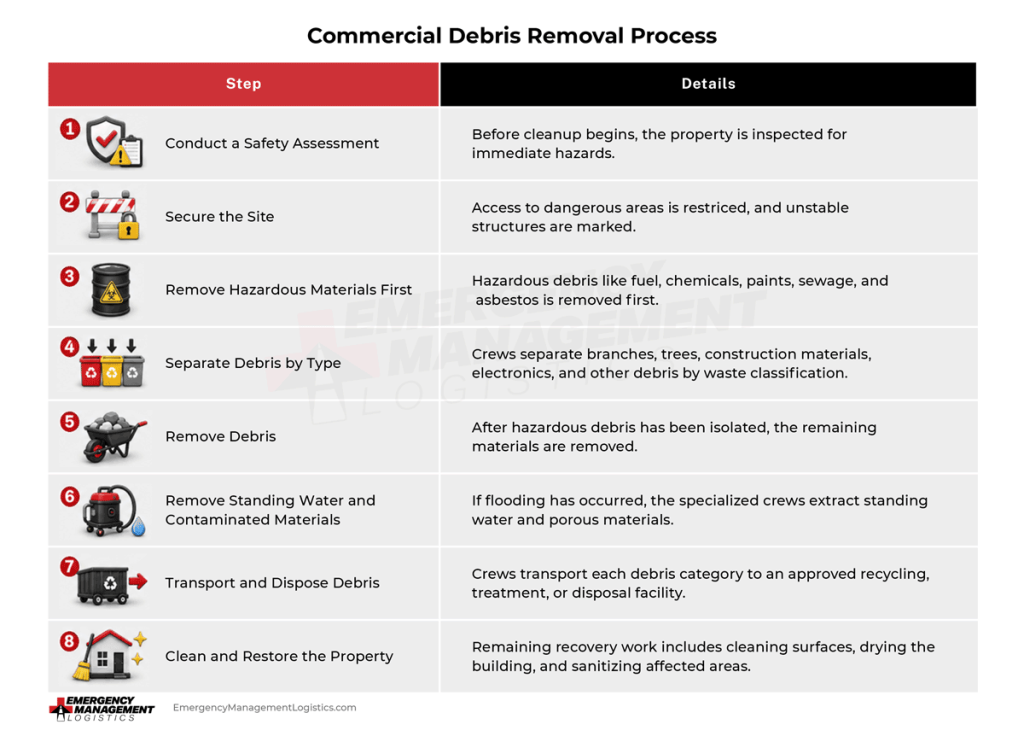
The cleanup sequence varies based on property damage, debris type, contamination, access conditions, and local disposal requirements. For example, removing hazardous materials might not be necessary if your place of business doesn’t handle these items or remains unaffected from floodwater after a hurricane.
Nonetheless, these eight steps are good to have at the ready to make cleanup as smooth as possible.
Structural, natural, and contaminated or hazardous debris can affect a commercial property.
Hurricanes can cause severe structural damage to buildings that result in large amounts of debris and waste that can litter a commercial property. This is often the result of powerful hurricane-force winds or flying objects.
Common types of structural debris include:
Natural debris that’s thrown around during a hurricane can block entrances, parking areas, loading zones, access roads, and emergency routes.
Common types of natural debris include:
Hurricanes can also leave behind hazardous and contaminated debris that pollute the inside of buildings.
Common types of hazardous and contaminated debris include:
In the case of structural and natural debris, heavy equipment may be needed to pick up and move the wreckage to another location. Hazardous and contaminated debris requires specialized equipment and careful handling to prevent harm to individuals and the surrounding environment.
Fast debris removal is essential to restoring access to your business, shortening business disruption, and protecting the health of the commercial property.
Fallen trees or power lines on your property or surrounding roads can prevent employees and customers from accessing your premises. Removing these obstacles ensures they can easily come and go from your commercial property without delays or exposure to safety hazards.
Debris leftover from a hurricane can leave damage to your business that raises recovery costs, slows down repairs, and potentially contaminates equipment and inventory. This contributes to extended business disruption. Fast debris removal shortens disruptions by removing wreckage, allowing you to focus on repairs and reopening your commercial property.
Quickly removing debris after a hurricane is essential to protecting the health of your commercial property. Floodwater in particular can lead to mold, reduced indoor air quality, and exposure to bacteria or sewage. Letting wreckage and contaminants linger in your commercial property leads to degradation and safety hazards.
Organizations like local municipalities, state governments, federal agencies, volunteer and nonprofit organizations, private contractors, and transportation providers participate in hurricane debris removal.
Here’s how each one helps remove wreckage after a hurricane:
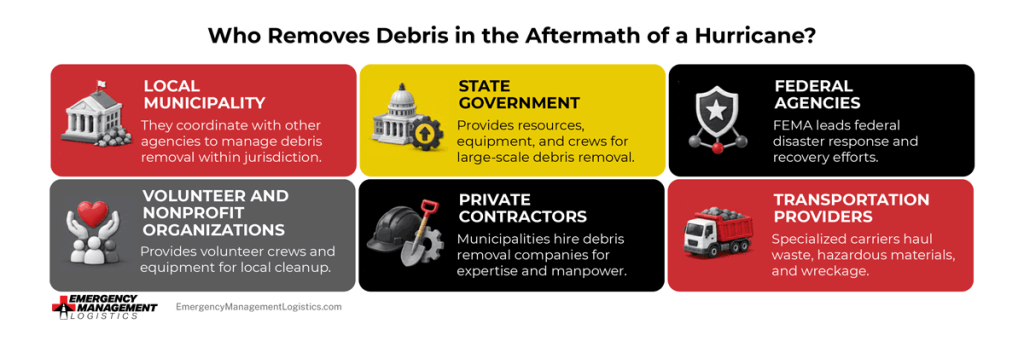
Transportation providers with disaster-logistics capabilities are a strong fit for large or multi-site commercial cleanup projects. They provide dedicated services to the customers who hire them, while the other organizations on this list are often tasked with spreading their resources to everyone in an affected community.
The wreckage leftover from a hurricane can be heavy and dangerous. Businesses don’t have the knowledge or equipment to handle debris carefully and remove it from their commercial property. That’s where transportation and emergency logistics providers come in to help.
They can provide assistance with the following:
Hiring an experienced disaster relief provider can streamline debris removal and help the business move into repair and reopening sooner.
Here at Emergency Management Logistics, we have the expertise, skill, and logistics network to quickly remove debris from your commercial property after a hurricane strikes. We also offer corporate emergency support, disaster relief, healthcare shipping, and consulting sessions.
If you need debris removal, or simply want to set up a disaster recovery plan, call our team at (855) 420-9447 or reach out to us on our contact page.
Sources:
National Preparedness, Federal Emergency Management Agency, 2026
Saffir-Sampson Hurricane Wind Scale, National Hurricane Center and Central Pacific Hurricane Center

