
Hurricanes Don't Wait.
Talk to our emergency logistics team before the next storm hits.
Get Help.


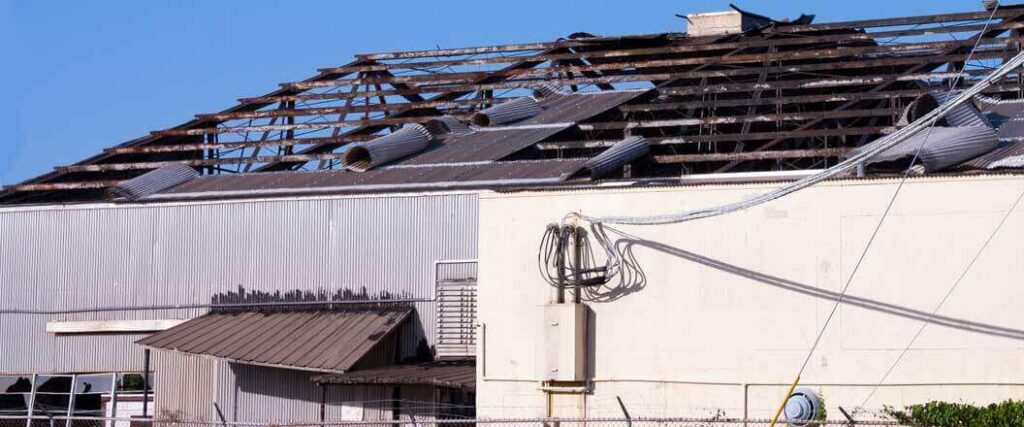
Post-hurricane recovery logistics involves coordinating all the people, transportation, storage, equipment, power, and information a business needs to resume operations after a storm. Once authorities permit safe access, the immediate logistics job after a major hurricane is to identify what must move first, where it can be received, which routes and carriers are available, and how affected inventory and debris will leave the site.
A building can be structurally usable and still be functionally useless to the business. Generators have not arrived. Inbound materials are stranded. Warehouse space is compromised. Drivers cannot reach the site. Customer orders are sitting in the wrong facility. A hurricane recovery logistics plan has to restore the flow of goods as deliberately as the recovery team restores the property.
Does this sound complicated? Honestly, it can be. But it does not have to be pure chaos. A post-hurricane logistics plan gives businesses an order of operations so they can recover, resume service, and support their communities as soon as conditions allow.
Emergency logistics is the coordinated movement and temporary positioning of the resources required for recovery. It connects the facility, workforce, suppliers, carriers, warehouses, utilities, contractors, and customers while normal operating conditions are unavailable.
Here’s a graphic that breaks down how emergency logistics help businesses and communities recover after a hurricane:
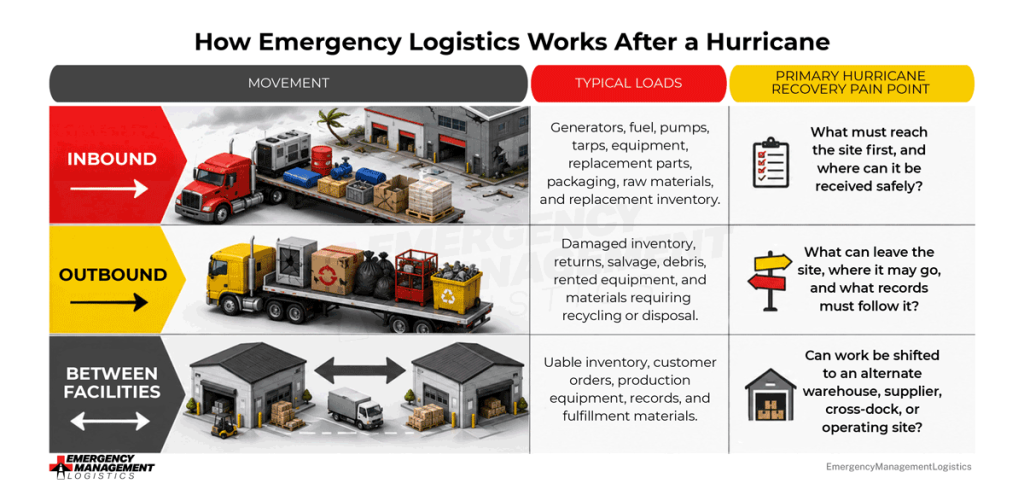
After a tropical storm or hurricane, the same truck entrance, dock, yard, or staging area may need to support all three movement flows—often at the same time, because disasters are famously considerate that way. Assigning priorities and controlling appointments can help prevent the recovery effort from creating a second bottleneck at the site.
Every storm creates different access, utility, and capacity constraints. Consider using this timeline as an order of operations rather than a promise that every facility will recover on the same timetable:
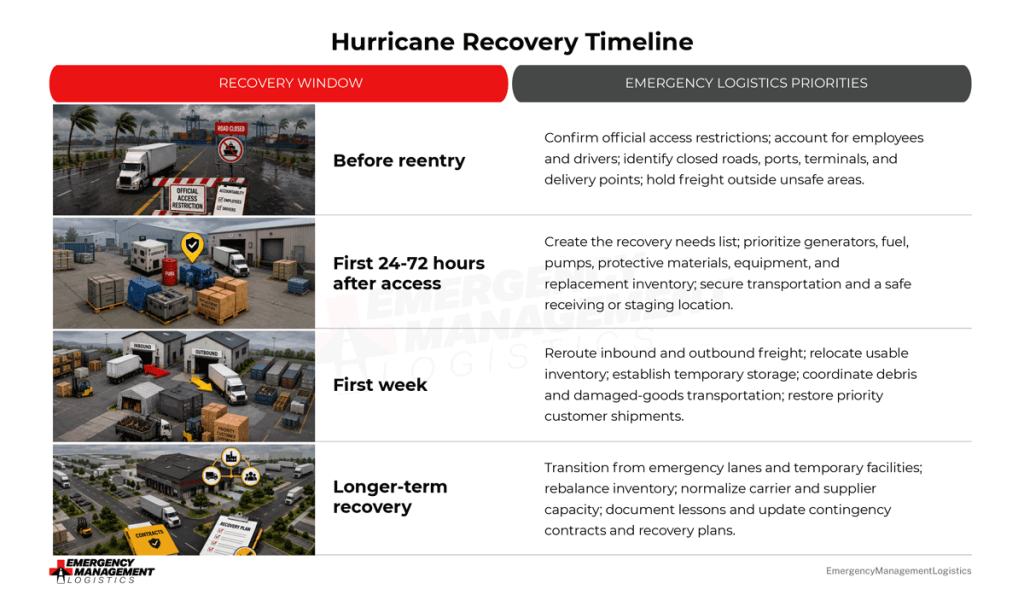
Here are ten steps to take as your business moves through the hurricane recovery timeline.
Wait for local emergency management and public safety officials to permit access. Then have qualified professionals evaluate structural, electrical, gas, floodwater, chemical, and falling-debris hazards before recovery work begins. OSHA requires employers to evaluate recovery tasks and protect workers from the hazards they are likely to encounter.
Logistics teams should verify more than whether a road appears open.
Confirm:
If portable generators are used, follow the CDC's generator and carbon-monoxide safety guidance and keep fuel-burning equipment outdoors and away from building openings.
Name one recovery logistics lead and establish one source of truth for requests, approvals, load status, facility conditions, and costs. This is not the moment for five spreadsheets, three group texts, and competing versions of what is supposedly arriving when.
Without central control, departments may compete for the same trailer, order duplicate equipment, send carriers to closed entrances, or prioritize loads that do not unlock a critical operation.
The logistics lead should coordinate with:
Use the company's supply chain continuity plan to identify preapproved alternatives, but update every assumption against current storm conditions.
Convert site assessments into a single list of physical resources and movements. Each request should identify the requesting function, item, quantity, pickup location, destination, required delivery window, handling requirements, receiving contact, and the operation that depends on it.
A practical priority order is:
Everything feels urgent after a hurricane. That does not mean everything gets top billing. When transportation and receiving capacity are scarce, labeling every request urgent makes it harder to protect the loads that actually control recovery.
When the site is safe, photograph and inventory affected property before it is relocated, cleaned, returned, salvaged, or disposed of. Yes, documentation can feel painfully administrative when the business is trying to get back on its feet.
It is also what helps establish what was damaged, where it went, what the recovery cost, and what an insurer may need to evaluate the claim. Notify the appropriate insurers promptly and ask what inspection, mitigation, transportation, storage, and disposal records they require.
For every inventory or equipment move, retain:
Documentation should not delay action against an immediate life-safety hazard. If material must move urgently, capture its condition first when it is safe and follow the instructions of insurers and appropriate authorities.
Carrier availability often tightens after a major storm at the exact moment demand for equipment, building materials, food, fuel, and replacement inventory rises. Normal routes may also be blocked by flooding, debris, port closures, damaged bridges, curfews, or fuel shortages. In other words, “our usual carrier normally handles this” is not a recovery strategy.
Review each critical lane for:
If a supplier is offline or cannot reach the affected area, activate a qualified fallback. See our guidance on finding alternate suppliers during an emergency and keeping freight moving during hurricane season.
When normal capacity is unavailable, Emergency Management Logistics, powered by R+L Global Logistics, can help coordinate expedited truckload shipping, disaster recovery transportation, temporary storage, and recovery equipment movements across a disrupted network. Explore disaster relief logistics services.
A damaged facility may not be able to receive freight even when the shipment can reach the area. Getting a truck through the county is not especially helpful if there is nowhere safe to unload it.
Identify where recovery loads will be accepted, inspected, staged, and released to the worksite. The answer may be an undamaged portion of the property, a nearby yard, a temporary warehouse, a cross-dock, or another company location.
The temporary location should support:
Use a staging area as a controlled buffer, not a vaguely organized pile of emergency supplies everyone assumes someone else is tracking. Assign every item an owner, status, destination, and release condition.
Temporary power is a logistics problem as well as a facilities problem. A generator does not simply materialize beside the building and begin solving things.
It must be correctly sized, transported, positioned, connected by qualified professionals, fueled, monitored, and eventually removed. The same is true for pumps, mobile lighting, refrigeration units, lifts, containers, and other rented equipment.
Before dispatch, confirm:
Having these details in order ensures all recovery resources are moved into the affected area with ease.
Moved is not the same as protected. Relocate salvageable inventory and equipment only after documenting its original condition and confirming the destination can actually protect it. Quarantine goods exposed to floodwater, temperature excursions, damaged packaging, sewage, chemicals, or other contaminants until qualified personnel determine whether they may be used, sold, returned, salvaged, or disposed of.
Maintain location and condition visibility through every handoff. For temperature-sensitive or regulated products, preserve monitoring data and required chain-of-custody records. For customer-owned cargo, communicate promptly and avoid making disposition decisions without the appropriate authorization.
Wet building materials and stored goods require rapid evaluation. The EPA's commercial-building mold guidance helps facility managers determine when professional remediation may be required.
Recovery traffic goes both ways. Damaged inventory, construction debris, vegetation, appliances, equipment, sediment, regulated materials, returns, and salvage may all need to leave the site—and each may require different staging, loading, transportation, recycling, or disposal methods.
Coordinate outbound movements so they do not block recovery deliveries or expose employees to work they are not trained and equipped to perform. Confirm material classification, container type, loading equipment, approved destination, permits or manifests, insurance requirements, and disposal documentation before pickup.
For detailed guidance on separation, staging, contractor selection, transportation, and disposal, see our guide to commercial debris removal after a hurricane.
A phased reopening may use an alternate warehouse, reduced production capacity, limited delivery zones, priority customer allocation, or temporary fulfillment through a partner location. The understandable temptation is to announce that the business is back as soon as the lights come on. First, verify the full order path: inventory availability, system access, labor, packaging, carrier capacity, dock operations, delivery appointments, and customer receiving conditions.
Communicate what is operating, what remains delayed, which orders are prioritized, and when the next update will be provided. As permanent utilities, facilities, and normal lanes return, deliberately close temporary locations and emergency contracts, reconcile inventory and costs, return rented equipment, and document lessons for the next continuity-plan update.

Emergency logistics connects the plans that businesses already use. A business continuity plan identifies the products, services, people, suppliers, facilities, and resources that must remain available. An IT disaster recovery plan restores data, applications, networks, and devices.
A post-hurricane logistics plan turns those priorities into physical movements, temporary locations, equipment, and delivery sequences. Put less corporately: the continuity plan says what matters, the IT plan restores the systems, and the logistics plan figures out how physical items get where they need to go.
Ready.gov and the U.S. Department of Homeland Security treat business continuity planning and IT disaster recovery planning as related parts of business preparedness. The logistics plan supplies the operational bridge between a recovery priority and the people or materials needed to execute it.
Here’s a checklist you should always follow when getting your logistics operations back online after a hurricane.
Carefully work through this checklist and double check your work to ensure you haven’t missed anything.
Hurricane recovery logistics tend to generate a lot of questions at the exact moment no one has time for vague answers. Here are straightforward answers to frequently asked questions about what businesses should move first, when temporary storage may be necessary, and where an emergency logistics provider fits into the recovery plan.
Post-hurricane emergency logistics is the coordination of transportation, temporary storage, staging, equipment, power, inventory movement, debris transportation, and shipment visibility needed to restore operations after a storm.
Prioritize items that protect life, stabilize the site, prevent additional loss, or unlock a critical business function. That may include protective equipment, pumps, generators, fuel, refrigeration support, communications equipment, replacement parts, or inventory needed for essential customer orders.
Temporary warehousing may be necessary when the normal facility is damaged, inaccessible, without power, unable to meet storage requirements, or too congested to receive both recovery supplies and normal freight. It can also support inventory relocation, cross-docking, order fulfillment, and controlled staging.
An emergency logistics provider can coordinate expedited transportation, alternate routes and carriers, emergency storage and warehousing, inventory relocation, recovery equipment and temporary power movements, and transportation for debris or damaged materials while the normal network is disrupted.
Use qualified support when debris is heavy, unstable, contaminated, regulated, mixed, difficult to access, or beyond the training and equipment of employees. The transportation plan should match each material with the proper container, loading method, records, and approved destination.
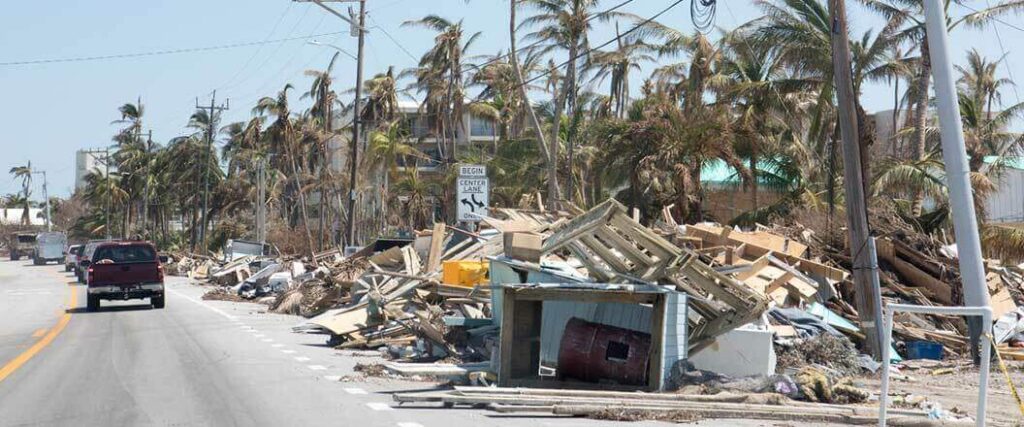
Hurricane recovery rarely presents businesses with one tidy transportation problem at a time. Critical supplies must move in, usable inventory may need to move between facilities, damaged materials must move out, and customer freight must resume across a disrupted network—often all at once.
Emergency Management Logistics helps businesses coordinate expedited truckload shipping, disaster recovery transportation, emergency storage and warehousing, and temporary power logistics. Call (855) 420-9447 or contact our emergency logistics team to discuss the loads, locations, equipment, and timelines controlling your recovery.
Sources:
OSHA Hurricane eMatrix: Employer Responsibilities - Worker safety, hazard evaluation, and recovery-task controls.
CDC: Safety After a Hurricane or Tropical Storm - Floodwater, electrical, cleanup, and generator safety.
EPA: Mold Remediation in Schools and Commercial Buildings - Moisture and mold evaluation for commercial facilities.
Ready.gov: Business Continuity Planning - Continuity planning and business disruption.
Ready.gov: IT Disaster Recovery Plan - Data, applications, and technology recovery.

