
Hurricanes Don't Wait.
Talk to our emergency logistics team before the next storm hits.
Get Help.


Hurricanes create havoc and destruction that affect the supply chain for businesses all across the country. Keeping your shipments moving when a hurricane strikes is essential for business continuity. Preparing your supply chain before a hurricane makes landfall is the best way to ensure your freight continues to move smoothly.
The heavy rain and hurricane-force winds make it difficult for shippers to move their freight in a variety of ways.
After a hurricane strikes, carriers and third-party logistics (3PL) companies often experience a spike in demand. They’re tasked with shipping humanitarian supplies, food and water, and emergency shelter to the affected areas. Carriers and 3PLs quickly run low on available drivers, equipment, and capacity during these periods of high demand.
Warehouses and distribution centers in a hurricane’s path often shut down before landfall to protect workers and secure their facilities. In some cases, facilities handling disaster-relief supplies may stay open.
The after-effects of a hurricane can also leave a warehouse or distribution center out of commission. Flooding and power outages make it impossible for facilities to operate. When warehouses and distribution centers aren’t operational, supply chains begin to stall.
The debris and flooding left in the wake of a hurricane can make roads dangerous, and in some cases, difficult to traverse. Carriers and 3PLs have a responsibility to deliver freight safely to the final destination, which means they’ll have to take detours around roads that can’t be used. Unfortunately, detours often extend the transit time of shipments.
A layover in freight transportation is an extended, unplanned delay where truck drivers have to stop between scheduled loads. Hurricanes frequently cause layovers by preventing truck drivers from picking up their next shipment. This can be due to flooding, closed warehouses, or other safety concerns.
Layovers not only make truck drivers responsible for their own food and lodging in the interim, but they also prevent freight shipments from moving through the supply chain.
Hurricanes increase demand for freight services, while decreasing the capacity of trucks, drivers, and equipment. Carriers and 3PLs raise rates to compensate for the imbalance.
Gas prices also rise after a hurricane, which contributes to higher shipping rates. Many refineries, pipelines, and fuel terminals in the U.S. are located along the Gulf Coast. When a hurricane comes through the Gulf Coast, refineries have to shut down and distribution operations are halted.
This reduces the supply of diesel, raising the cost of fuel. Carriers and 3PLs offset these higher costs by increasing shipping rates.
To soften the impact of hurricanes on your supply chain, you should diversify your carriers, insure shipments, review your shipping documentation, establish backup routes, and build emergency inventory.
Hurricanes affect the operational capabilities of carriers in the area they make landfall. If you’re only relying on trucking companies in the areas affected by a hurricane to move your freight, your shipments will likely come to a halt. Diversifying your carriers is one of the best ways to ensure your freight keeps moving before, during, and after a hurricane.
Here’s a table outlining the different methods you can use to diversify your carriers.
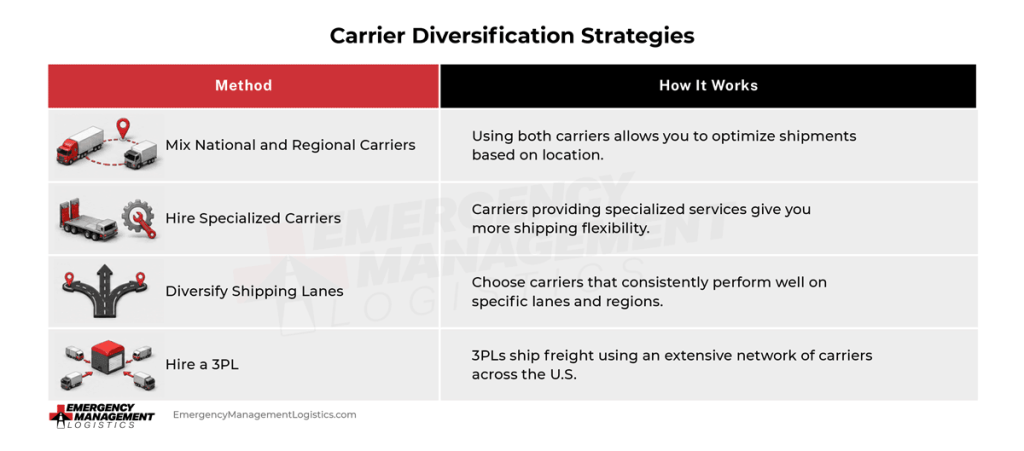
Carrier diversification isn’t just a good way to overcome delays caused by hurricanes. It can also help you overcome supply chain disruptions caused by other natural disasters or geopolitical events.
Hurricanes pose a significant threat to freight that’s in transit. Roads can still be dangerous for freight to travel on after a hurricane has passed. Getting insurance - or confirming that your existing policy covers storm-related events - is a great way to protect yourself financially if something goes wrong.
Incorrect shipping documents can complicate a shipment, especially after a hurricane. Correcting paperwork can be more difficult once freight transportation has been disrupted.
Here’s a graphic of the documents used in freight shipping that you should check.
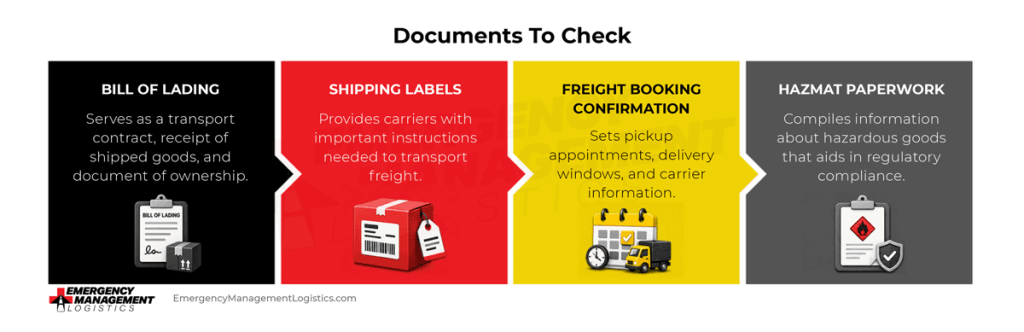
Checking these documents for accuracy can help you avoid unnecessary complications caused by a hurricane.
Establishing backup routes helps you redirect shipments if a hurricane floods a portion of a route or blocks it with debris. Without backup routes in place, shipments already in transit may be delayed after a hurricane passes.
Most carriers are scrambling to redirect shipments after a hurricane, which leads to congestion. Selecting backup routes ahead of time will help you avoid this problem while everyone else has to start from scratch.
Building up inventory before hurricane season helps businesses maintain adequate stock levels if products are damaged or supply chains are disrupted. Hurricanes can lead to flooding, roof cave-ins, and high winds that can damage or destroy inventory. Extra inventory helps businesses replace the goods they’ve lost.
Transportation is slowed or halted by a hurricane, which makes it difficult for businesses to restore their inventory levels. Growing inventory before a hurricane allows your business to avoid shortages.
If there are cracks in your supply chain, a hurricane will expose them. It’s better that you identify vulnerabilities before a storm hits. Here’s a table with the aspects of your supply chain you should check before a hurricane makes landfall.
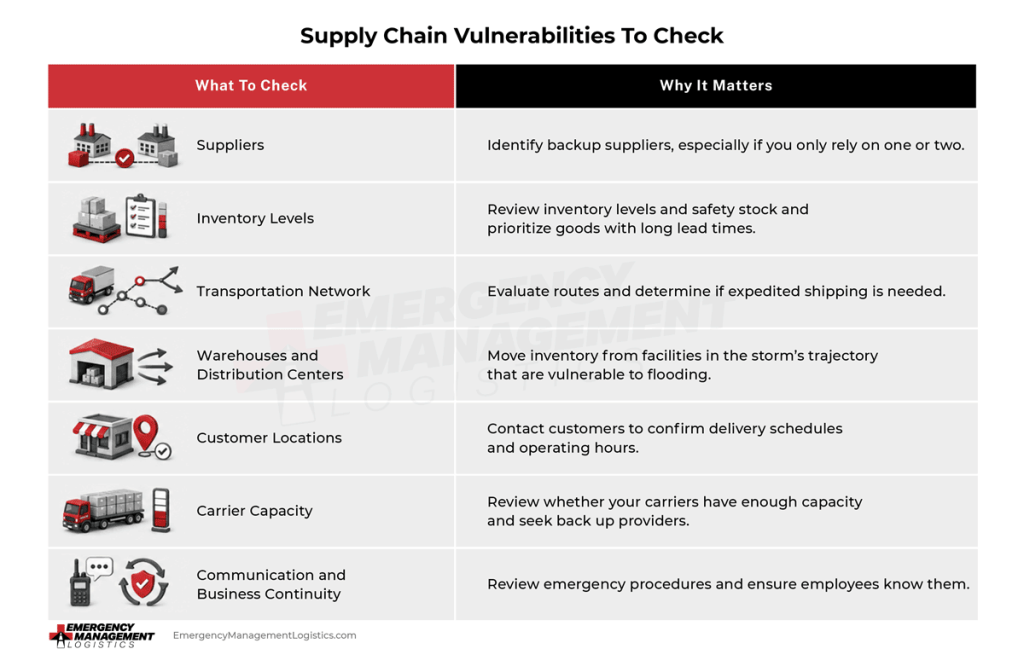
Strengthening your supply chain before a hurricane strikes helps reduce disruptions and keeps freight moving.
Shippers can watch for hurricane freight risks by tracking the storm, staying in contact with carriers, and monitoring railroads, roadways, and shipments.
Here’s how you can monitor each one:
Tracking these items will keep your shipments safe in the uncertainty and danger brought by a hurricane.
Freight shipments can be rerouted before a hurricane hits by dispatching loads early, selecting alternate highway routes, staging trucks outside impact zones, delivering to alternate facilities, or delaying departures.
Shippers have a variety of options available to them, depending on their circumstances. Regardless of the option you choose, it’s best to plan your rerouted shipments before a hurricane makes landfall.
Emergency Management Logistics has a vast network of carriers and warehouses ready to help your business run during a hurricane. From corporate emergencies, to disaster relief and healthcare crises, we can help you overcome all the challenges hurricanes can bring. Call our team at (855) 420-9447 or reach out to us on our contact page.
Sources:
Seven-Day Graphical Tropical Weather Outlook, National Hurricane Center and Central Pacific Hurricane Center
Location, Pipeline 101

