
Hurricanes Don't Wait.
Talk to our emergency logistics team before the next storm hits.
Get Help.


Freight affected by a warehouse flood should be isolated and evaluated to determine if it should be released, reconditioned, returned, or destroyed. The outcome depends on the type of freight, whether the floodwater made contact with it, how it was packaged, and if temperature or contamination controls were affected by the flooding.
The warehouse flood recovery process usually involves seven freight decisions:
For businesses with flooded warehouses or inventory in the affected supply chain, getting the water out is only the beginning. Here’s what happens after a flood and how to start the recovery process.
The first priority after a warehouse flood is separating potentially affected freight from inventory that is known to be safe.
Think of this as a quarantine period for the shipment. Freight that was submerged, splashed, stored on wet pallets, or exposed to contaminated packaging after a warehouse flood should not immediately return to normal inventory.
Why? Floodwater is not simply rainwater once it enters streets, buildings and industrial areas. The Environmental Protection Agency (EPA) is a government agency that protects human and environmental health from various threats, such as floodwater. The EPA advises treating floodwater as potentially contaminated with sewage or hazardous chemicals.
Create a clearly identified hold area and separate freight by exposure:
Do not move questionable freight to another customer, warehouse, or distribution center simply to clear space. That can turn one contaminated location into a much larger inventory problem.
Before damaged freight disappears into dumpsters, salvage loads, or replacement shipments, create a record of what happened during the warehouse flood.
After a warehouse flood, photograph and document:
Documentation after a warehouse flood matters because insurance adjusters may need evidence of both the damaged property and its value. Indiana's Department of Insurance recommends maintaining a list of damaged or lost items, including age and value when possible, and providing receipts or other documentation to the adjuster.
The exact claim process depends on your insurance policies, ownership of the goods, warehouse agreements, and other contractual responsibilities. Notify the appropriate insurer, broker or risk-management team early rather than assuming which coverage applies.
And unless safety or regulators require immediate disposal, document first and discard second.
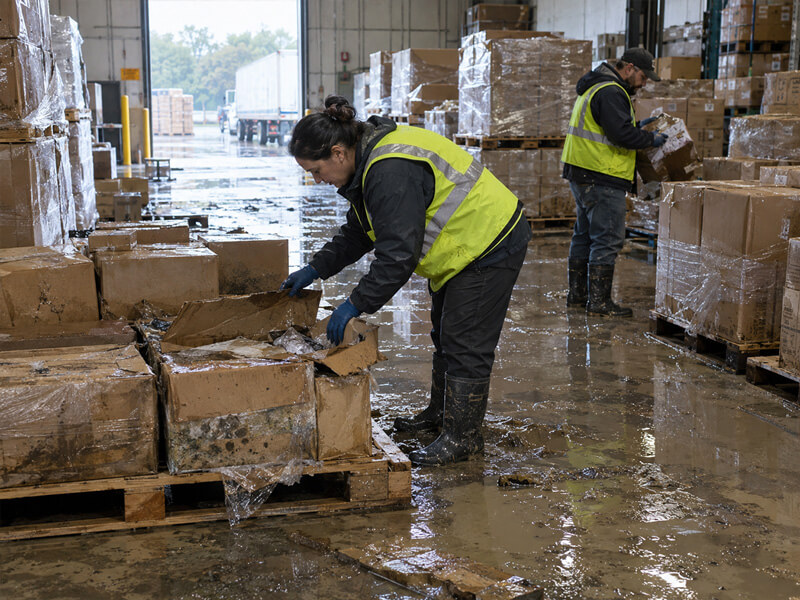
Visible water damage after a warehouse flood is only one part of the assessment.
Floodwater can carry biological contaminants, chemicals, and other hazards. Moisture can also penetrate corrugated cartons, labels, wood pallets, and other porous materials even when the product itself is not completely underwater. EPA guidance also warns that damp materials can develop mold if they remain wet, creating additional health and cleanup concerns.
The important question becomes: Did the flood affect only the shipping material, or did it compromise the actual product?
That answer can completely change what happens next.
A machine inside a protective enclosure may have a very different salvage path than food, pharmaceuticals, chemicals, or absorbent consumer goods.
Sometimes flood-damaged freight can be salvaged. Other times, it can’t.
There is no universal rule for ordinary commercial freight in disaster relief logistics. Salvageability depends on the commodity, packaging, degree of exposure, contamination risk, and whether the product can safely be inspected, cleaned, or reconditioned.
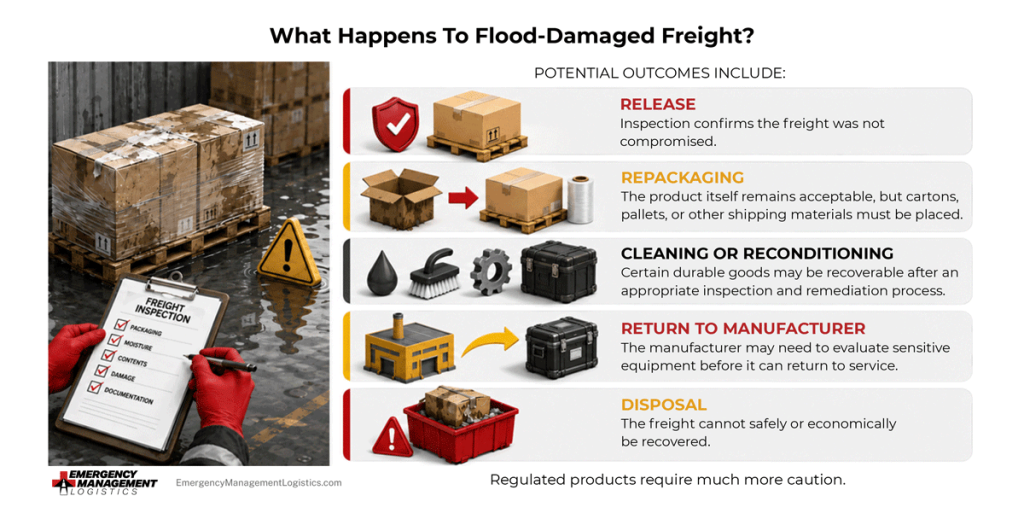
Potential outcomes include:
Regulated products require much more caution.
For contaminated products, disposal itself can require significant planning. The Food and Drug Administration (FDA) is a U.S. government agency dedicated to protecting public health.
FDA guidance is particularly strict for food exposed to floodwater. Food and packaging submerged in floodwater generally should be discarded unless the product is in an undamaged, commercially sealed hermetic container that can be safely reconditioned. Food packed in water-damaged paper, cardboard, plastic, cloth, and similar materials should not be salvaged.
That matters for warehouses storing groceries, ingredients, beverages, and other food products: an intact-looking case does not necessarily mean the inventory is safe to redistribute.
Like with food products, FDA guidance recommends discarding drugs that have come into contact with floodwater or unsafe municipal water because contamination can create serious health risks, even when some medicines remain in their original containers.
Food, pharmaceuticals, medical products, chemicals, and other regulated commodities may therefore require input from regulators, manufacturers, or qualified specialists before anyone makes a salvage decision.
Once the inventory assessment is complete, divide the freight into clear disposition categories. A useful working structure is:
This is where emergency management logistics becomes important again.
Damaged freight may need transportation to a salvage operation, manufacturer, disposal facility or alternate warehouse. Replacement inventory may simultaneously need to move into the affected market.
Flood-damaged chemicals and other hazardous materials should not simply be mixed with ordinary debris. EPA advises separating leaking or damaged chemical containers and coordinating appropriate disposal rather than pouring, burning, or combining unknown materials. Disposal is sometimes a logistics project of its own.
Inventory recovery and financial recovery should happen in parallel.
For each affected SKU or shipment, maintain a record of:
Those records can help adjusters determine the loss and can also prevent confusion later when hundreds or thousands of units have been moved, destroyed or replaced.
Do not assume the claim ends with the value of the product itself. Depending on the applicable coverage and circumstances, there may also be costs associated with cleanup, debris removal, temporary storage, transportation, and business interruption. Flood coverage is policy-specific, so businesses should work directly with their insurance and risk-management professionals to determine what their coverage allows.
Even salvageable freight may need somewhere else to go. A flooded warehouse may remain unusable while the facility is dried, cleaned, inspected and repaired. Power outages, damaged racking, contaminated floors or restricted road access can also prevent normal operations. That creates an immediate emergency warehousing problem.
Businesses may need temporary space where unaffected or cleared inventory can be:
Emergency Management Logistics provides emergency storage and warehousing as part of its disaster-recovery support, along with transportation options for moving inventory during supply-chain disruptions.
Moving usable inventory out of the affected building can allow the physical warehouse cleanup to continue without unnecessarily stopping distribution.
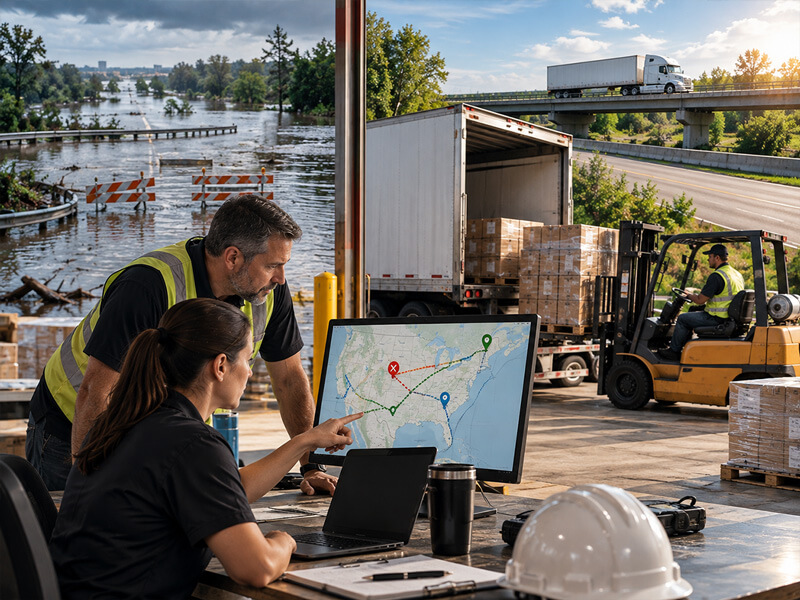
For many businesses, the biggest operational problem is not what was lost. It's what customers still need tomorrow.
Once damaged inventory has been identified, determine which products are critical to ongoing operations. Ask: What do we have to replace first to keep the business running?
Replacement inventory may need to come from another distribution center, supplier, manufacturing facility or warehouse.
After a regional flood, normal routing may also be unavailable. For example, the August 2026 Indiana floods washed out and closed roads in multiple counties, including portions of Wayne, Henry, Randolph, and other central and east-central Indiana communities.
That can require:
Emergency freight options can help bridge the gap when waiting for ordinary replenishment would extend a shutdown. Emergency Management Logistics supports expedited truckload and other time-critical freight options designed for supply-chain disruptions.
The immediate aftermath of a warehouse flood understandably centers on water damage.
But recovery quickly becomes more complicated.
Some freight must be quarantined. Some can be salvaged. Some require regulatory review. Some become part of an insurance claim. Some must be transported for disposal. And some need to be replaced immediately so customers, production lines or critical operations are not left waiting.
The faster a business can separate what is safe, what is lost and what must be replaced, the faster logistics teams can begin building the recovery path.
Between August 11 and 17, 2026, repeated thunderstorms brought more than a foot of rain to some parts of central Indiana. The National Weather Service (NWS) is a government agency that provides weather, water, and climate data, forecasts, and hazardous weather warnings.
The NWS reported washed-out roads, significant property damage and record flooding along portions of the White River, including communities in central and east-central Indiana.
While this derecho event was unprecedented for Indiana, the risk of severe flooding and flood damages is increasing across the country as the 2026-27 “Super El Niño” strengthens and weather patterns become more unpredictable.
The historic August 2026 flooding in Indiana is a reminder that businesses do not need to lose an entire facility for a flood to disrupt their supply chains. Damaged inventory, closed roads, power outages, and inaccessible warehouse space can create problems well beyond the original water line.
Warehouse flood recovery comes down to a few critical decisions: quarantine exposed freight, document the loss, assess contamination, determine what can be salvaged, begin the claims process, and identify what needs to be disposed of or replaced.
From there, the focus shifts from damage assessment to keeping the supply chain moving.
What to do: Quarantine flood-exposed freight, document the damage, assess contamination, determine what can be salvaged, start the claims process, and separate inventory that must be disposed of or replaced.
Where Emergency Management Logistics comes in: If the warehouse cannot resume normal operations, unaffected or recoverable freight may need temporary storage while replacement inventory is sourced and moved through alternate routes. Emergency warehousing, expedited transportation and time-critical freight can help keep critical products moving during recovery.
Outcome: The goal is to quickly separate what is safe, what is lost, and what must be replaced, then rebuild the supply chain around the inventory and facilities that remain available.
Need help? Emergency Management Logistics can coordinate temporary warehousing, expedited replacement freight and alternate transportation when flooding disrupts normal operations. Call (855) 420-9447 or request an emergency logistics quote to start planning your recovery.

